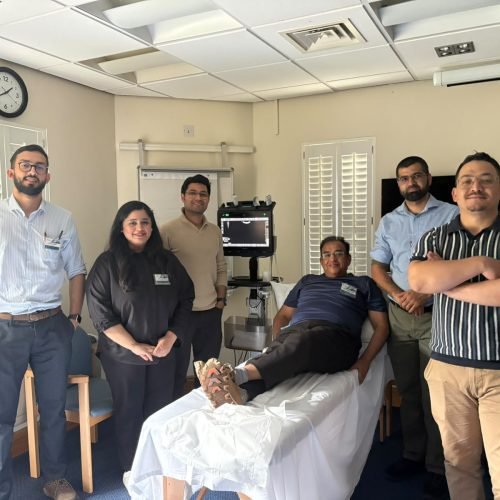
Advancing Acute Care Through Point-of-Care Ultrasound, Innovation and Multidisciplinary Collaboration

The course was aimed at healthcare professionals interested in developing their knowledge and practical skills in ultrasound-assisted lumbar puncture, particularly clinicians working in acute, emergency, medical, and procedural settings.
Delegates will be introduced to a systematic approach to lung ultrasound before spending substantial time applying those principles practically.
The programme will cover pleural line assessment and lung sliding, A-lines and B-lines, interstitial patterns, consolidation and air bronchograms, pleural effusions, pneumothorax including the lung point and M-mode appearances, and ultrasound assessment of pleural fluid.
Throughout the course, the emphasis will remain on interpreting these findings within the clinical picture and understanding how bedside ultrasound can contribute to acute decision-making.
The course then progresses from identifying pleural pathology to understanding the practical principles of chest tube insertion.
Using dedicated simulation equipment, delegates will have opportunities to work through patient and site assessment, safe procedural principles, equipment familiarisation, insertion technique, securing and connecting the drain, and important considerations following insertion.
The objective is not simply to demonstrate a procedure. Participants will be able to practise the steps themselves in a controlled educational setting with faculty guidance.
Successful chest drain care does not finish with insertion.
The programme will therefore explore the practical aspects of chest drain management, including common issues that clinicians may encounter after a drain has been placed.
Clinical scenarios will connect these skills with real-world decision-making, helping delegates develop an approach that extends from initial ultrasound assessment through intervention and subsequent management.
The educational approach reflects a core principle of POCUS Wales:
Less passive listening. More supervised practice.
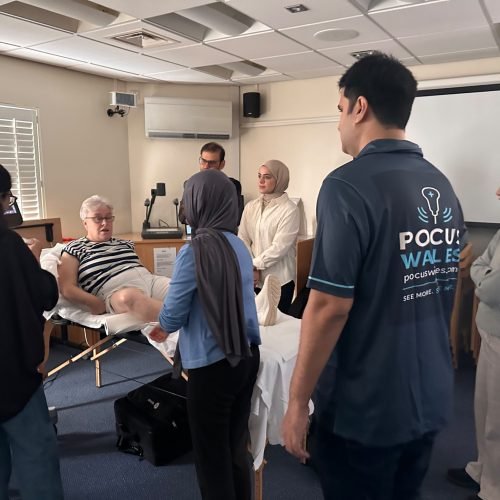
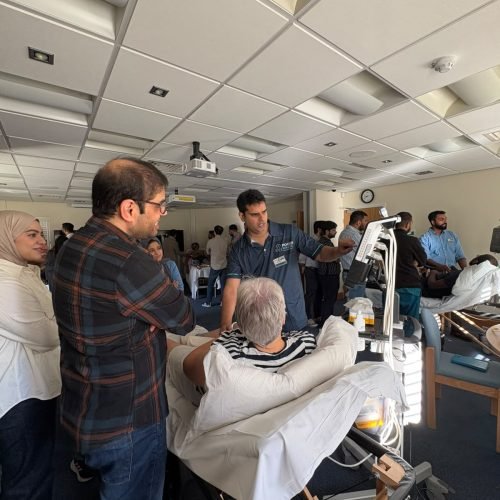
Delegates will rotate through practical stations, work with ultrasound equipment and simulation models, and receive direct faculty guidance as they develop their technique.
The aim is for participants to finish the course with a clearer framework for recognising pleural pathology, approaching chest tube insertion safely and understanding the principles of ongoing drain management.
The course is particularly relevant to doctors and other appropriately qualified healthcare professionals working in Acute Medicine, Internal Medicine, Emergency Medicine, Respiratory Medicine, Critical Care and other specialties involved in the assessment of acutely unwell patients and pleural disease.
Previous ultrasound experience may be helpful, but it is not essential for clinicians beginning to develop their lung ultrasound skills.
Recognise the pathology. Understand the anatomy. Practise the procedure. Manage the drain.
Join POCUS Wales for a dedicated day of practical lung ultrasound and pleural procedural education.
Saturday, 14 November 2026
Wrexham Medical Institute, Wrexham
For enquiries and booking: events@pocuswales.com